Account Segregation for Crowdlending Investor Protection under Swiss Law
12.02.2026
7 min
Updated: 29.07.2026
One of the nations that enjoys the greatest reputation as a haven for stability and reliability is Switzerland, and deservingly so. Its banks are known for being conservative, the franc – for being stable, and its independent central bank has upheld stability throughout the nation in times of stress. This has bred a deep legal and institutional tradition specifically to protect financiers and safeguard objects, going as far back to the Swiss Code of Obligations in the early 20th century. The same legal principles and values are applied to its regulation of crowdlending.
Among the chief traditions enforced under the law is account segregation. Under the law, assets entrusted to financial intermediaries or must be kept separate from company operational assets. This means that even in the event of a bankruptcy, client capital cannot be used to satisfy liabilities and must be returned in full to their rightful owners. This legal safeguard is a cornerstone of issuer confidence, enabling Switzerland to maintain its reputation as a secure destination for capital.
In this piece, we will discuss the pieces of legislation governing these resources and how those frameworks apply within the digital realm.
In This Article
Legal Framework
Valuables held with financial intermediaries, including crowdlending operators, are protected through a combination of the Federal Act on Intermediated Securities, the Banking Act, and the Financial Market Infrastructure Act. Central to this framework is that holdings and securities must be kept separate from the assets of the operator itself, thereby significantly reducing the risk of misappropriation.
The Banking Act: Article 37D
The Banking Act was originally adopted in 1934 and later was amended to mandate that custody holdings with banks and similar financial institutions follow the loss-allocation rules established in FISA. In practice, this integration means that client capital cannot be commingled with the bank’s own property. If an operator were to become insolvent, this legal structure ensures that valuables are protected from the operator’s creditors, further safeguarding capital invested through various third-party organizations.
Federal Act on Intermediated Securities (FISA): Article 11A
This states that when client securities are held by a custodian abroad through a foreign sub‑custodian, Paragraphs 3 and 4 impose strict obligations: the custodian must either ensure that issuer and custodian property is kept separate from each other in foreign holdings or implement alternative measures providing a comparable level of protection if legal or operational constraints prevent full separation. This ensures they’re protected even in cross‑border custody arrangements.
The Financial Market Infrastructure Act (FMIA): Article 73
Adopted in 2003, and since modified regularly, FMIA extends these protective principles to participants of central securities depositories, such as banks or financial institutions managing securities on behalf of financiers. FMIA requires participants to be offered a choice between omnibus accounts (where multiple client holdings are pooled but kept aside from intermediary assets) and individually reserved holdings, where each financier’s property is set aside.
Digital Application
In simple terms, holdings dissociation means that capital provided by issuers is kept legally and operationally somewhere else. The organization may facilitate the transaction, but it does not treat investor capital as its own property. This is a structural safeguard with direct legal consequences.
In the P2P context, issuers transfer money for the specific purpose of financing projects for applicants. Until those funds are disbursed or, where applicable, returned, they represent third-party assets held for a limited and defined purpose. The organization cannot freely dispose of the money, use it for its own liquidity needs, or expose it to its own business risks.
This approach is reflected in the way Swiss-based crowdlending platforms such as Maclear structure their operations. Lender capital is held in dedicated holdings physically dissociated from company operational balances, ensuring that uninvested capital remains ring-fenced at all times. This structure is in accordance with civil law and the organization’s role as an intermediary.
Preventing Risk
This standard significantly reduces counterparty risk. If investor funds were held in platform holdings, lenders would effectively become unsecured creditors of the organization. In contrast, segregated accounts clarify that the capital belongs to the financiers and is held only on a pass-through basis.
Swiss Financial Market Supervisory Authority (FINMA) and Self-Regulatory Organizations
The effectiveness of Swiss law is reinforced through a layered system of regulatory and self-regulatory oversight, primarily involving FINMA and FINMA-recognised self-regulatory organisations. FINMA’s role is to define and police the regulatory perimeter. Third-party organizations are assessed based on the economic substance of their activities, with particular focus on how investor capital is handled.
Outfits must affiliate with a FINMA-recognised SRO. This is where preventive lender protection becomes particularly tangible. SROs do not merely check transactions for AML purposes – they impose organisational, governance, and control requirements that directly reinforce holdings segregation and protection.
Polyreg
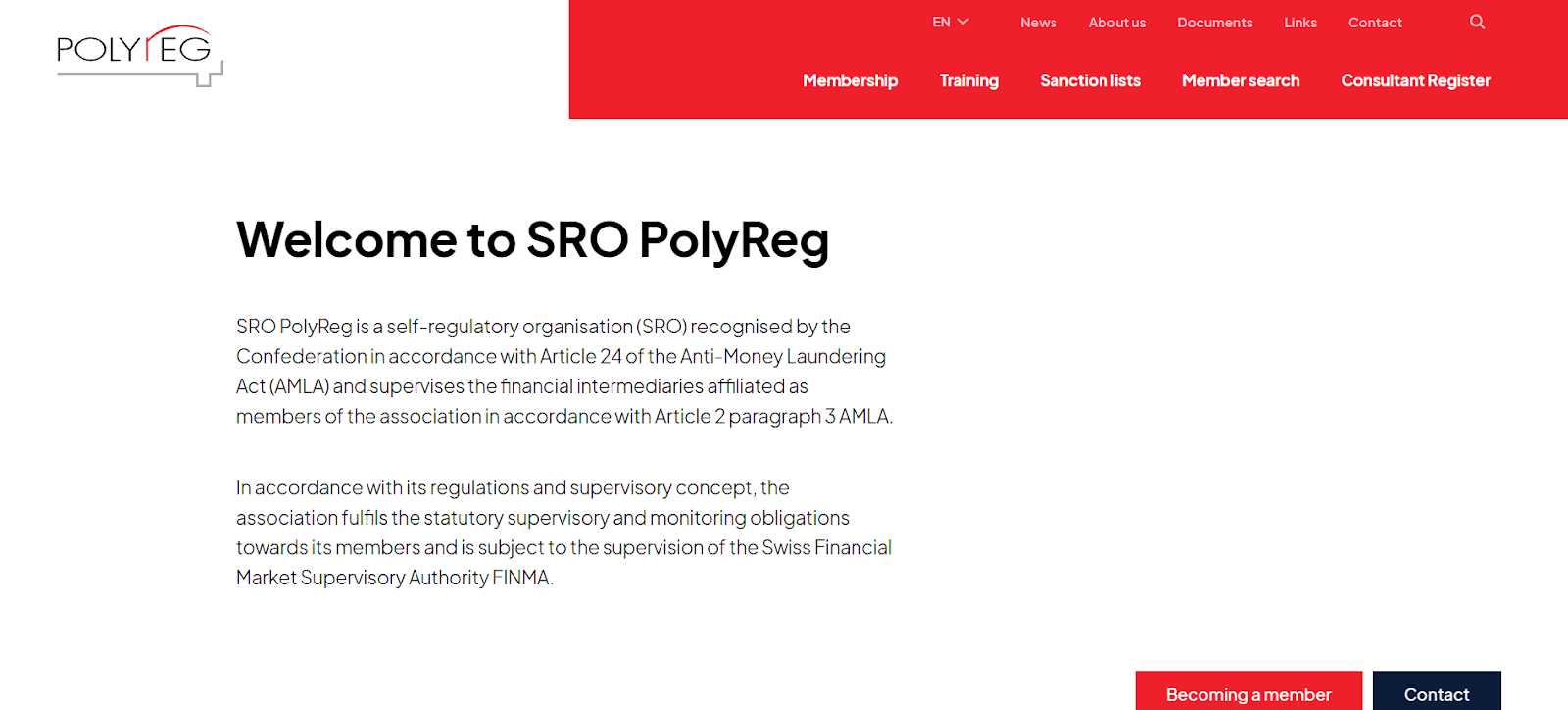
For instance, membership in PolyReg illustrates how this system operates in practice. PolyReg is a long-established SRO with more than 25 years of operating history, operating under FINMA’s supervision. Admission to PolyReg’s members list is not automatic. Before commencing operations, organizations like Maclear undergo a multi-stage vetting process that includes:
a financial solvency review
a comprehensive reputation check of shareholders and management,
verification that the management team possessed the professional competence required to act as a financial intermediary.
This admission process functions as a structural filter, preventing poorly governed or undercapitalised outfits from entering the market.
Regular Audits
Crucially, SRO supervision is continuous, not one-off. Maclear is subject to mandatory annual inspections and audits to confirm ongoing compliance with rules, AML obligations, internal controls, and governance standards. These reviews ensure that funds remain properly dissociated, traceable, and protected from operational use, not just at launch but throughout its lifecycle. Holdings dissociation is legally anchored, regulatorily enforced, and operationally monitored.
Protection During Insolvency
Where investor funds are properly segregated, they do not form part of the third party’s bankruptcy estate, as the Code of Obligations states. Cash balances, as well as loan claims arising from transactions, are treated as third-party holdings. In the event of insolvency, the insolvency administrator is legally obliged to exclude these holdings from the estate and return them to the financiers to whom they belong. Participants are therefore not treated as unsecured creditors of the organization, but as owners of identifiable assets held on a fiduciary basis.
Traceability Maintained
Insolvency law places strong emphasis on whether holdings can be clearly identified and attributed to specific financiers. Dissociated handling ensures this traceability by maintaining a clear divide between investor and organization property, supported by transaction records and balance documentation. Where such a divide exists, property is shielded from claims by outfit creditors, regardless of their financial condition.
Repayment Rights Retained
This framework also extends beyond idle cash. Loan receivables generated through investments are likewise protected. Even if a platform ceases operations, the underlying loan agreements remain valid, and capital providers remain entitled to repayment directly from the borrowers. Insolvency does not extinguish these claims, nor does it allow them to be absorbed into the organization’s liabilities.
How Shareholder Property Cannot Be Used
These balances cannot be used for any ordinary expenses or obligations of the transaction facilitator, such as:
Technological development
Salaries
Marketing
Administrative expenses
Covering third-party obligations
Each transaction must be documented with precision, linking every investment to a specific issuer and project. Organizations maintain detailed ledgers that record deposits, disbursements to project developers, interest payments, and repayments of principal. Any misallocation or mixing of holdings would expose the organization to civil and regulatory liabilities.
Automated Attribution
Finally, account segregation is supported by technology. Crowdfunding organizations deploy banking integration systems, automated accounting, and reconciliation software to manage multiple investor accounts efficiently. Such systems reduce human error, ensure timely reporting, and allow lenders to track the status of their contributions in real time, thereby enhancing transparency and trust.
Conclusion
The requirement to dissociate the assets of stakeholders is a cornerstone of Switzerland’s long-standing approach to ultimate stakeholder security and respect for the legal standards. Through statutes such as the Banking Act, FISA, and FMIA, legislation ensures that virtual cash held by third parties remain distinct from organization holdings and protected from operational or insolvency risk.
For stakeholders, this distinction is critical. While investors consciously assume borrower credit risk, they are shielded from becoming unsecured creditors of the platform itself. Segregated accounts, reinforced by FINMA oversight and continuous supervision by recognised self-regulatory organisations, ensure that currencies and claims remain traceable, legally protected, and recoverable even in adverse scenarios.
Maclear demonstrates how these protections are applied in practice. Beyond strict account segregation and ongoing SRO supervision by Polyreg, Maclear adds further layers of risk management through an innovative 10-point credit scoring system, a dual-layer default protection, and assuming the handling of any possible international disputes for stakeholders.
For those seeking a crowdlending platform built on Swiss legal certainty and enhanced by disciplined risk controls, Maclear offers a framework where lender protection is structural, transparent, and actively managed.